
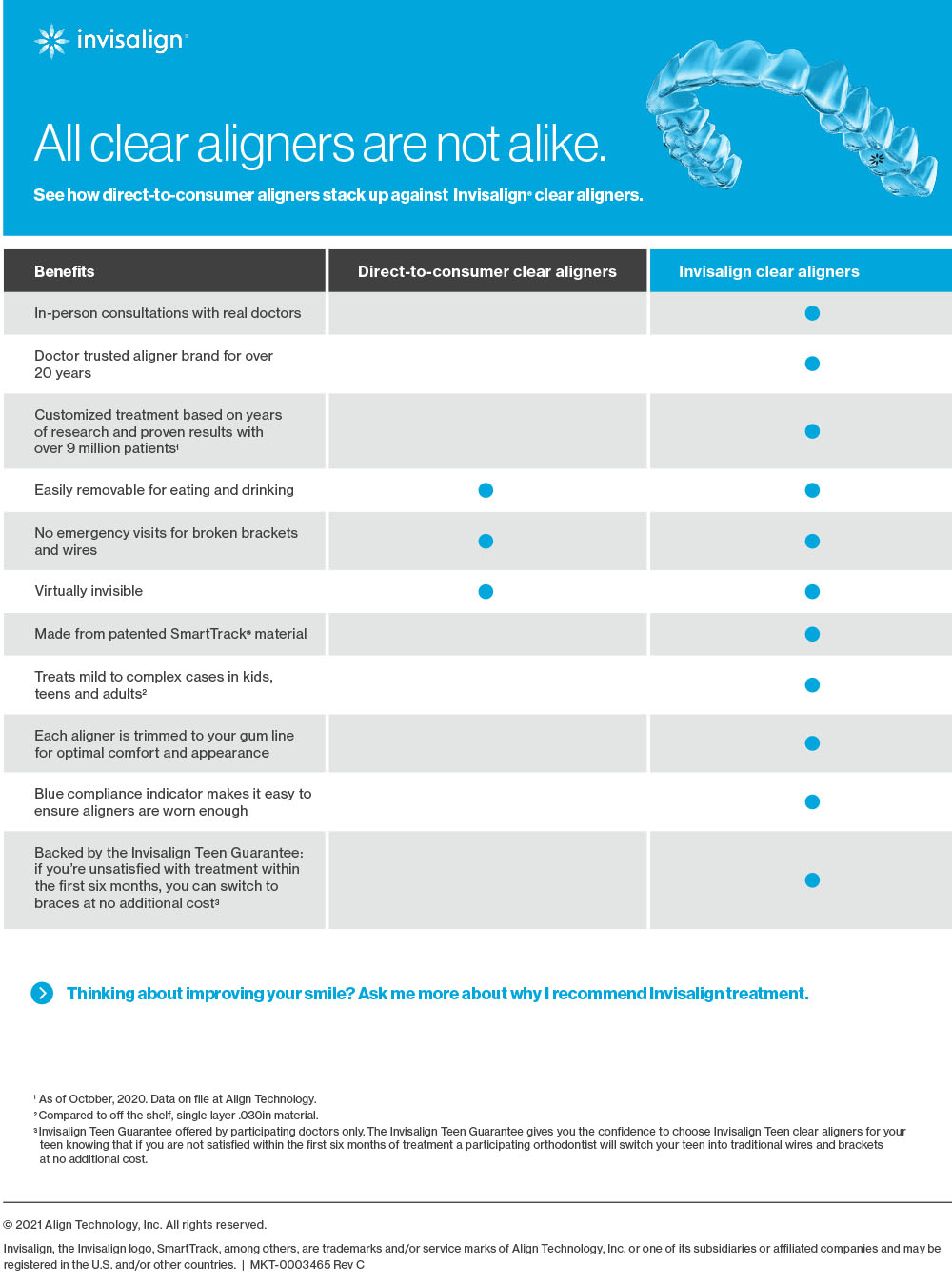
The rise of direct-to-consumer (DTC) aligner companies—which advertise mail-order clear aligners without in-person examination by a licensed dentist or orthodontist—has created an important distinction that patients considering orthodontic treatment should understand. While DTC aligners are marketed as a convenient, lower-cost alternative to Invisalign®, the professional and clinical differences between the two approaches are substantial and carry real implications for patient safety and treatment outcomes.
Invisalign® treatment begins with a comprehensive evaluation that includes clinical examination, photographs, dental X-rays, and digital scans. This evaluation allows the dental provider to assess not only tooth positions but also the health of the teeth, gum tissue, and underlying bone—conditions that significantly affect whether orthodontic treatment is safe and appropriate. Patients with active decay, gum disease, or bone loss may worsen these conditions dramatically if tooth movement is applied without treating underlying disease first.
DTC aligner companies typically use only impressions or scans taken by the patient at home or at a scanning center, without any clinical examination of the teeth and gums, without X-rays, and without evaluation by a licensed dental professional who physically examines the patient. This means significant pathology can be missed before aligner treatment begins.
Invisalign® treatment is monitored by a trained dental provider throughout the treatment process. Progress appointments allow the provider to assess tooth movement, identify any unexpected changes, check the health of the gum tissue, and modify the treatment plan if needed. DTC aligner treatment is typically conducted entirely remotely, with no in-person monitoring. Problems that develop during treatment—root resorption, gum recession, bite changes, or tooth loosening—may go undetected until significant damage has occurred.
Invisalign® treatment is prescribed and supervised by a licensed dental professional who bears professional and legal responsibility for the outcomes. DTC aligner companies use various arrangements to nominally satisfy regulatory requirements while minimizing professional involvement in the actual treatment decisions. Major dental and orthodontic organizations have issued warnings about DTC aligner companies citing patient safety concerns.
At Cameron Park Dental Care, Invisalign® treatment is provided by a trained, licensed provider who examines your teeth in person, plans your treatment individually, and monitors your progress throughout. For safe, supervised orthodontic care, call us at (530) 676-0400 or contact us online.
Direct-to-consumer (DTC) aligner companies sell clear aligner orthodontic products directly to consumers through online platforms, without requiring an in-person examination by a dentist or orthodontist. Patients take their own impressions at home using a mail-in kit, or visit a scanning center for a digital scan. The impressions are used to fabricate a series of aligners that are mailed to the patient. Treatment is monitored remotely through photos submitted via a smartphone app, without in-person examination by a licensed provider.
DTC aligners are significantly less expensive than Invisalign® or braces, which is their primary marketing advantage. However, the reduced cost reflects reduced professional involvement—no in-person examination, no X-rays, no clinical monitoring by a dentist who can see and feel the teeth, gums, and bone.
Invisalign® treatment is prescribed and supervised by a licensed dental professional who performs a thorough in-person evaluation before treatment begins, including clinical examination, X-rays, and digital scans. This allows the provider to identify conditions that would make orthodontic treatment unsafe—such as active decay, gum disease, bone loss, or short dental roots—and to treat those conditions before applying orthodontic forces. It also establishes professional accountability for the treatment plan and outcomes.
DTC aligners bypass this evaluation, meaning significant dental problems can go undetected when treatment begins. Moving teeth through diseased bone or in patients with active gum disease can accelerate bone loss and cause permanent damage. Major dental organizations—including the American Association of Orthodontists and the American Dental Association—have issued consumer alerts warning about the risks of DTC aligner treatment.
Yes—documented cases of harm from DTC aligner treatment have been reported, including accelerated bone loss, gum recession, root resorption (where the roots of the teeth shorten due to excessive orthodontic force), bite worsening, and relapse. When these problems develop without in-person monitoring, they may progress significantly before the patient is aware of them.
Movement of teeth through bone that has been weakened by periodontal disease is particularly dangerous—the forces of tooth movement can cause rapid, irreversible bone loss in compromised tissue. A patient who appears to have healthy-looking gums but has not had a clinical examination including probing and X-rays may have significant underlying bone loss that makes orthodontic treatment dangerous without prior treatment.
DTC aligners are typically marketed at costs significantly lower than Invisalign®—often in the range of one-third to one-half the cost of professionally supervised clear aligner treatment. This price difference is the primary appeal of the DTC model. The lower cost reflects the elimination of professional examination, X-rays, in-person monitoring, and the overhead associated with professional dental care.
Patients who experience problems from DTC aligner treatment—worsened gum disease, bone loss, bite issues, or root damage—often face significant costs for restorative and periodontal treatment to address the resulting damage. The upfront savings can be substantially outweighed by the downstream costs of addressing complications. This risk calculus is worth considering when comparing costs.
Major professional dental and orthodontic organizations have expressed significant concerns about DTC aligner companies. The American Association of Orthodontists has issued consumer alerts warning that DTC orthodontic treatment without in-person examination and supervision poses patient safety risks. The American Dental Association has similarly cautioned against orthodontic treatment without appropriate examination and professional oversight. Several state dental boards have investigated DTC companies for practicing dentistry without a license.
These warnings reflect the consistent professional view that safe orthodontic treatment requires in-person evaluation by a licensed provider who can assess the full clinical picture—including conditions not visible in a smartphone photo or a patient-taken impression—before and during tooth movement.
Yes—patients who have started DTC aligner treatment and are concerned about their progress or have experienced problems can seek evaluation and transition to professionally supervised care. At a consultation, we evaluate the current state of your teeth, gum tissue, and bone to understand where treatment has brought you and what, if any, issues have developed. Based on this evaluation, we can recommend whether Invisalign®, traditional orthodontics, or other treatment is most appropriate going forward.
If DTC treatment has caused gum disease, bone loss, or other complications, those conditions must be addressed before new orthodontic forces are applied. An honest evaluation will identify what has occurred and what the realistic options are for addressing it. We approach these situations without judgment—our focus is on understanding your current clinical situation and helping you move forward from it.
For most patients, yes. The additional cost of Invisalign® over DTC aligners pays for: an in-person examination that confirms you are a suitable candidate for orthodontic treatment before any tooth movement begins; professional X-rays that assess bone levels, root anatomy, and conditions not visible on the surface; a customized treatment plan with professional oversight throughout; in-person monitoring at regular intervals to detect and address any issues; and professional accountability for outcomes.
The risk of undetected and unmonitored problems with DTC treatment—and the potential cost of addressing resulting complications—makes the price differential look different when the full picture is considered. The decision to move teeth is a significant clinical intervention. Professional supervision is not an optional luxury; it is a safety requirement for responsible orthodontic care.
Some patients complete DTC aligner treatment without any apparent problems. This does not mean the treatment was without risk—it means, at minimum, that no obvious harm occurred in that person’s case. Without clinical examination and X-rays before and after treatment, it is not possible to know whether more subtle changes—such as early bone loss or root shortening—occurred without producing noticeable symptoms.
Patient outcomes with DTC aligners vary. Cases involving simple, limited tooth movements in patients who happen to have healthy bone and no underlying conditions may proceed without serious incident. The problem is that without a professional evaluation, neither the patient nor the DTC company can know in advance which cases are safe to treat without supervision and which are not. That determination requires clinical examination by a licensed professional—which is precisely what DTC companies bypass.
Signs that something may have gone wrong with DTC aligner treatment include new or worsening gum recession, increased tooth sensitivity, teeth feeling loose or mobile, bite feeling different or uncomfortable, pain in the jaw joints or muscles, and teeth that look different in position than expected. If you notice any of these changes during or after DTC aligner treatment, seek an in-person dental evaluation promptly.
Some forms of damage—bone loss, root shortening—produce no symptoms until they are advanced. If you have completed DTC aligner treatment and have not had a professional dental examination during or after treatment, scheduling a comprehensive evaluation including X-rays is strongly recommended to confirm the health of your teeth and supporting structures.
At Cameron Park Dental Care, all orthodontic treatment begins with a thorough in-person evaluation that includes clinical examination, appropriate X-rays, and digital scans. We identify any conditions that must be addressed before orthodontic forces are applied, develop a treatment plan specifically for each patient’s anatomy and goals, and provide regular in-person monitoring throughout treatment. This is the standard of care that protects patient safety and produces predictable, lasting results.
If you are considering clear aligner treatment—or if you have concerns about DTC aligner treatment you have already started—call us at (530) 676-0400 or contact us online to schedule a consultation. We are here to provide the professional care and honest guidance you deserve.