
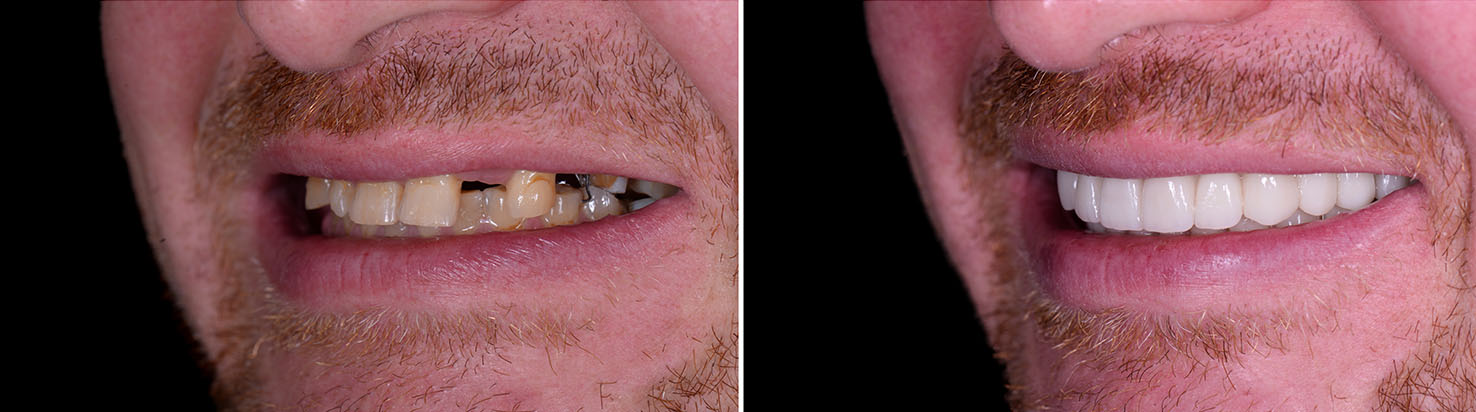
All-on-6® is a full-arch dental implant solution that uses six implants per arch to support a complete, fixed set of replacement teeth. Like All-on-4®, it is designed to replace all of the teeth in an arch with a prosthesis that stays in place permanently—no removal, no adhesives, no compromise. The additional implants in All-on-6® provide more support points across the arch, which can enhance stability and load distribution for the right patients.
The fundamental philosophy of All-on-6® is the same as All-on-4®—using a minimal number of strategically placed implants to support a full-arch fixed prosthesis. All-on-6® uses six implants rather than four, with the additional implants typically placed further back in the arch. This greater distribution of support can be advantageous when the patient has sufficient bone volume to accommodate six implants and when additional support would improve the long-term stability of the restoration.
For patients with good bone quality and volume across most of the arch, All-on-6® may offer enhanced load sharing and potentially greater long-term durability of the prosthesis. The appropriate choice between All-on-4® and All-on-6® depends on an individual assessment of bone anatomy, overall health, and the specific requirements of the restoration.
The treatment process for All-on-6® follows a similar path to All-on-4®. After a comprehensive evaluation including CBCT imaging, the six implants are placed in a single surgical appointment. A temporary prosthesis is typically attached the same day, allowing patients to leave with functional teeth while the implants integrate with the bone over the following months. Once integration is confirmed, the final custom prosthesis is fabricated and placed.
Both All-on-4® and All-on-6® provide stability, function, and esthetics that traditional removable dentures cannot match. The prosthesis is fixed—it does not move during eating or speaking. Patients can enjoy a full diet, maintain normal oral hygiene with brushing and flossing, and smile with confidence. The implants also stimulate the underlying bone, helping to preserve jawbone volume over time.
At Cameron Park Dental Care, we evaluate each patient thoroughly to determine whether All-on-4®, All-on-6®, or another approach best serves their needs and anatomy. If you are missing most or all of your teeth and are looking for a permanent solution, call us at (530) 676-0400 or contact us online to schedule a consultation.
All-on-6® is a full-arch dental implant system that uses six titanium implants per arch to anchor a fixed prosthesis replacing all of the teeth in that arch. The implants are surgically placed into the jawbone, where they fuse with the bone over a period of months in a process called osseointegration. Once integrated, they provide a stable foundation for a permanent bridge or prosthesis.
A key feature of the All-on-6® approach is that a temporary prosthesis is placed the same day as the implant surgery, so patients leave with functional teeth immediately. The final prosthesis is placed after full osseointegration is confirmed, typically three to six months after surgery.
All-on-6® uses six implants per arch compared to four in the All-on-4® system. The two additional implants provide more support points distributed across the arch, which can be beneficial for patients who have adequate bone volume in the posterior jaw and for whom additional implant support would improve the durability and stability of the restoration.
All-on-4® uses angled rear implants to compensate for reduced posterior bone volume, making it ideal for patients with some degree of bone loss. All-on-6® is often appropriate when bone volume is good throughout the arch and more uniform implant distribution is possible. The best choice depends on individual anatomy and is determined at consultation with CBCT imaging.
Not universally—the best number of implants depends on the individual patient’s bone anatomy, the span and weight of the prosthesis, and clinical factors. Six implants distribute load across more points, which can reduce stress on individual implants and potentially extend the longevity of the restoration. For patients with good bone volume throughout the arch, All-on-6® may offer advantages in terms of stability and load sharing.
For patients with significant posterior bone loss, All-on-4® with angled implants may be the more appropriate and equally effective solution. The goal is to select the approach that provides the best outcome for each specific patient’s anatomy, not to maximize or minimize the number of implants arbitrarily.
Yes—in the All-on-6® protocol, a temporary prosthesis is placed on the same day as the implant surgery in most cases. This immediate loading approach means you leave the appointment with a functional set of teeth attached to the implants. The temporary prosthesis protects the implants during the healing period and allows you to eat, speak, and smile normally while osseointegration occurs.
The temporary prosthesis is a transitional appliance. After the implants have fully integrated—typically three to six months after placement—the temporary prosthesis is replaced with the final custom restoration, which is designed for long-term wear, optimal function, and natural esthetics.
The overall timeline from the initial consultation to placement of the final prosthesis is typically six to nine months, though this varies by individual. The surgical appointment—during which implants are placed and the temporary prosthesis is attached—is one day. The healing and osseointegration period that follows takes three to six months. During this time, you are functioning with the temporary prosthesis.
Once osseointegration is confirmed with follow-up imaging, impressions are taken for the final prosthesis, which is fabricated in a dental laboratory. Placement of the final prosthesis and any necessary adjustments adds additional appointments to the timeline. Your specific schedule will depend on healing speed, any additional procedures needed, and laboratory turnaround time.
Daily maintenance for All-on-6® involves brushing the prosthesis thoroughly with a soft toothbrush, cleaning beneath the bridge with a water flosser or implant floss, and rinsing with an antimicrobial mouth rinse. The goal is to prevent plaque and bacteria from accumulating around the implants and in the tissue beneath the prosthesis, where peri-implantitis (implant infection) can develop if hygiene is neglected.
Professional maintenance appointments every six months (or more frequently as recommended) are also essential. At these appointments, the team professionally cleans beneath the prosthesis, evaluates the health of the peri-implant tissue, checks bone levels, and assesses the condition of the restoration. Consistent professional monitoring protects the long-term success of the implants.
Coverage for All-on-6® varies significantly by insurance plan. Some plans provide partial coverage for dental implants as a restorative procedure, while others exclude implants entirely. The prosthesis attached to the implants may have separate coverage considerations. Medical insurance may provide some coverage in cases where tooth loss is related to a medical condition or injury.
We recommend contacting your insurance provider before your consultation to understand your specific benefits. Our team can assist with pre-authorization requests and provide the documentation typically required to support insurance claims. We can also discuss payment and financing options to help make treatment accessible.
All-on-6® is a well-established, extensively studied treatment with high success rates in properly selected patients. As with any surgical procedure, risks exist, including infection, bleeding, nerve sensitivity, and—the most significant implant-specific risk—implant failure. Implant failure can occur early during healing or later due to infection (peri-implantitis) or excessive force. Risk factors include smoking, uncontrolled diabetes, and poor oral hygiene.
We discuss all relevant risks and how to minimize them at the consultation appointment. Patients who are medically suitable, who maintain good oral hygiene, and who attend regular professional maintenance appointments have consistently high long-term success rates with implant-supported full-arch restorations.
Yes—transitioning from removable dentures to a fixed All-on-6® restoration is one of the most common scenarios for this treatment. Many patients who have worn dentures for years are excellent candidates for implant-supported fixed restoration. The evaluation will assess how much bone remains after years of wearing dentures (bone resorption occurs more rapidly without tooth roots stimulating the jaw), which influences the implant planning process.
Some patients who have worn dentures for a long time may have experienced significant bone loss that requires evaluation for grafting or that influences the choice between All-on-4® and All-on-6®. The CBCT scan taken at evaluation provides the detailed three-dimensional view of remaining bone needed to plan the most appropriate approach.
At Cameron Park Dental Care, we provide comprehensive evaluations to determine which full-arch implant approach is best suited to your specific anatomy, health, and goals. We take the time to explain the process, set realistic expectations, and ensure you are fully informed before moving forward. Our priority is a result that genuinely improves your quality of life for years to come.
If you are interested in learning whether All-on-6® or another full-arch solution is right for you, call us at (530) 676-0400 or contact us online to schedule a consultation in Cameron Park.