
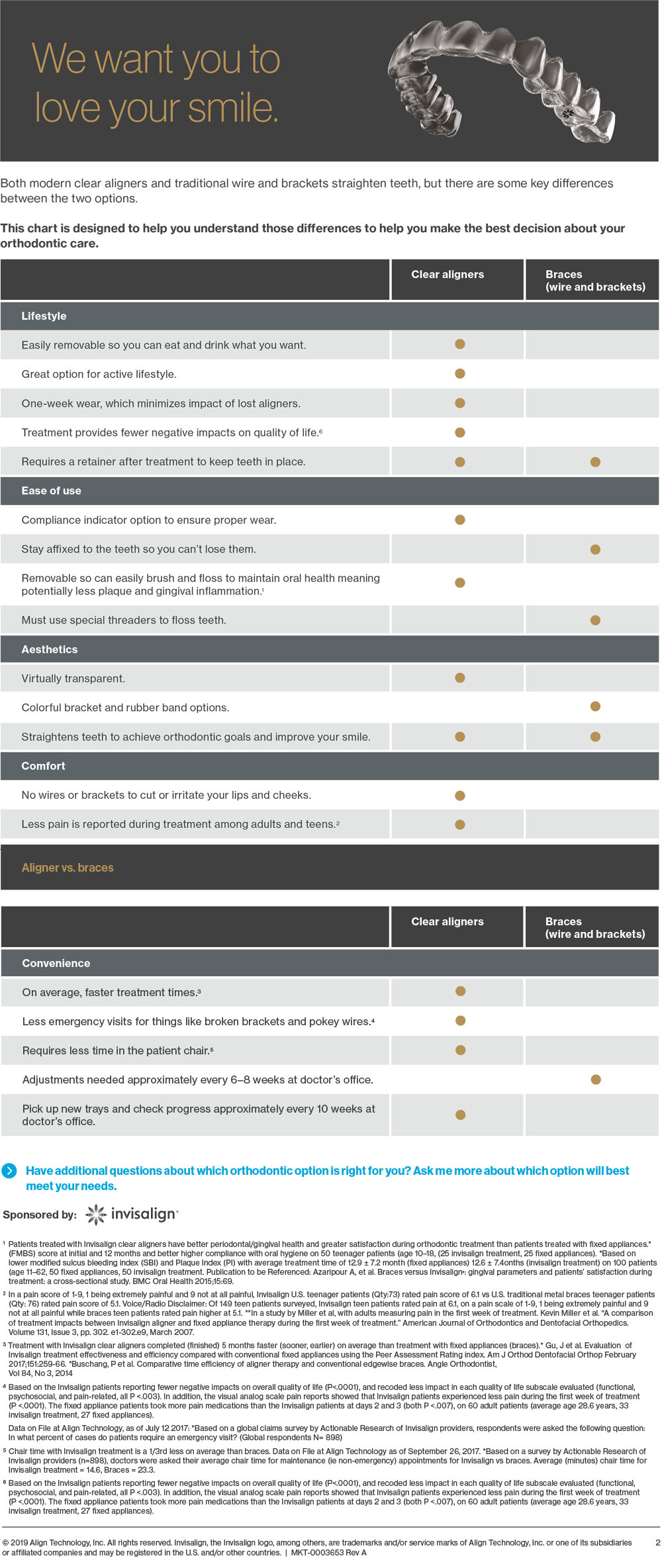
Choosing between Invisalign® clear aligners and traditional metal braces is one of the most common decisions patients face when considering orthodontic treatment. Both are effective orthodontic systems with long track records, and both can produce excellent results for appropriate cases. The right choice depends on the nature and complexity of the orthodontic problem, the patient’s lifestyle and priorities, and an honest assessment of which system will achieve the best outcome most efficiently for each individual.
This is the most visible difference and the most common reason patients ask about Invisalign®. Clear aligners are nearly invisible when worn—most people, including the person wearing them, find them much less noticeable than metal brackets and wires. For adults and older teenagers for whom the social and professional visibility of braces is a significant concern, Invisalign® offers a major quality-of-life advantage. Traditional braces are visible, though ceramic or clear brackets are a less conspicuous alternative to metal.
Invisalign® aligners have no sharp metal edges and cause fewer soft tissue injuries than braces. The soreness associated with each new aligner or wire adjustment is similar in nature but generally reported as more manageable with Invisalign®. The removability of Invisalign® allows unrestricted eating, normal brushing and flossing, and the freedom to remove aligners for specific activities. Braces restrict certain foods and require more complex oral hygiene around brackets and wires throughout treatment.
Traditional braces have a longer history and can achieve a broader range of tooth movements with greater predictability, particularly for complex cases. They are attached to the teeth and work continuously regardless of patient behavior. Invisalign® has significantly expanded its capabilities in recent years and achieves excellent results for most mild to moderate orthodontic cases, and many complex ones—but its effectiveness depends heavily on the patient wearing aligners for 20 to 22 hours per day. Compliance is the key variable that can make Invisalign® underperform relative to braces for some patients.
At Cameron Park Dental Care, we evaluate each patient’s orthodontic needs carefully and provide honest guidance about which system—Invisalign®, ClearCorrect®, traditional braces, or a referral to a specialist—is most likely to achieve the best result. Call us at (530) 676-0400 or contact us online to schedule an orthodontic consultation.
The fundamental difference is that Invisalign® uses a series of removable, clear plastic aligners to move teeth gradually, while traditional braces use brackets bonded to the teeth connected by wires that are adjusted periodically by the orthodontist or dentist. Invisalign® aligners are nearly invisible and can be removed for eating and oral hygiene; braces are visible and are permanently attached for the duration of treatment.
Both systems move teeth through bone by applying controlled forces. The mechanism of force application is different—aligners apply sequential, staged pressures through the shaped trays, while braces use wire tension and elastics—but the biological process of bone remodeling that allows tooth movement is the same. Both can achieve excellent results for appropriate cases.
For most mild to moderate orthodontic cases, Invisalign® achieves results comparable to traditional braces in the hands of an experienced provider. The clinical capabilities of Invisalign® have expanded substantially over the past decade, and it can now address crowding, spacing, overbite, underbite, crossbite, and open bite conditions that previously required braces or were beyond aligner capabilities.
For the most complex cases—severe crowding requiring extractions, significant vertical movement, complex skeletal discrepancies—traditional braces or orthognathic surgery combined with braces may offer more predictable control. The compliance factor is also significant: Invisalign® depends on the patient wearing aligners consistently. For patients who will not reliably maintain 20 to 22 hours per day of wear, braces may provide more consistent results because they work continuously.
Most patients find Invisalign® somewhat more comfortable than traditional braces throughout treatment. Both systems cause mild soreness when teeth are being actively moved—with braces after wire adjustments, and with Invisalign® for the first few days of each new aligner. The nature of this discomfort is similar. However, braces can additionally cause irritation of the inner cheeks and lips from brackets and wire ends, which Invisalign® aligners (being smooth plastic) do not cause.
Comfort varies by individual and by the specific teeth being moved at each stage. Some patients report more discomfort with aligners than braces; many report the opposite. Overall, the smooth plastic profile of Invisalign® trays and the absence of metal components in the mouth is a meaningful comfort advantage for most patients throughout treatment.
Treatment duration for both Invisalign® and traditional braces depends primarily on the complexity of the case rather than the system used. Simple cases can be completed in months with either system; complex cases may take two years or more with either. There is no inherent speed advantage of one system over the other for equivalent case complexity when treatment proceeds as planned.
One practical difference: missed or delayed braces adjustment appointments slow treatment. Missed or delayed aligner advancement due to insufficient wear time also slows Invisalign® treatment. Patients who comply consistently with either system typically complete treatment close to the estimated timeline.
Yes—Invisalign® aligners are removed for eating, so there are no dietary restrictions during treatment. With traditional braces, certain foods must be avoided throughout treatment: sticky foods (caramel, gum), hard foods (ice, hard candy, popcorn kernels), and foods that can be caught in brackets (corn on the cob, whole apples). These restrictions can be frustrating for patients over the months or years of treatment.
The freedom to eat without restriction is one of the most practically appreciated advantages of Invisalign®. The discipline required is removing the aligners before eating, cleaning the teeth before replacing them, and wearing the aligners for the recommended 20 to 22 hours daily despite the interruptions for meals and snacks.
The cost of Invisalign® and traditional braces varies by provider, geographic area, and case complexity. For comparable cases, Invisalign® and traditional braces are often similarly priced—sometimes Invisalign® is slightly more expensive, sometimes comparable. The cost range for both is significant, with simple cases being less expensive than complex ones for either system.
Insurance benefits for orthodontic treatment (when available) can typically be applied to either system. Financing options are available to make either approach accessible with monthly payment plans. We provide a specific cost estimate at the consultation based on your individual case.
Invisalign® is particularly popular among adults, largely because of its near-invisible appearance and its compatibility with professional and social settings where metal braces might cause self-consciousness. The ability to remove aligners for important meetings, presentations, first dates, or special events is a practical advantage that resonates with many adult patients.
That said, braces are entirely appropriate for adults and are chosen by many adults who either have cases that are better suited to fixed appliances or who prefer not to manage the compliance demands of removable aligners. Age is not a clinical factor in the effectiveness of either system—the decision should be based on the clinical needs of the case and the patient’s lifestyle priorities.
Oral hygiene during Invisalign® is virtually unchanged from normal—remove the aligners, brush normally, floss normally, and replace the aligners. The removability of the trays means there are no brackets or wires to navigate around with special tools. This is a significant practical advantage for patients who prioritize easy oral hygiene or who are prone to cavities and gum disease.
Oral hygiene with braces requires more effort. Brushing around brackets and under wires requires specific techniques and ideally an interdental brush or water flosser. Flossing requires a floss threader or orthodontic floss to pass floss beneath the wire at each tooth. Patients with braces who do not maintain rigorous hygiene are at increased risk of cavities around brackets and gum inflammation throughout treatment.
For contact sports, Invisalign® offers a significant safety advantage: the aligners can be removed and a properly fitted mouthguard worn during the activity, then the aligners replaced afterward. Metal braces worn during contact sports can cause serious lacerations to the inner cheeks and lips if the face receives a blow. Athletes in contact sports who must wear braces need a specially fitted orthodontic mouthguard that covers the brackets, which is bulkier and less protective than a custom mouthguard over natural teeth.
For non-contact sports, both systems are equally compatible. Some athletes find the smooth plastic of Invisalign® aligners more comfortable during athletic activity than the metal of braces. We discuss sport participation and mouthguard options at the consultation for all patients with athletic commitments.
At Cameron Park Dental Care, we provide honest guidance about which orthodontic approach is most appropriate for each patient’s specific case—not based on which is easier to offer but on which will produce the best clinical outcome for the individual. We are clear about the cases where Invisalign® is an excellent choice, the cases where traditional braces or specialist referral would serve the patient better, and the cases where the choice is genuinely a matter of patient preference.
If you are weighing Invisalign® against braces and want a thorough, honest evaluation, call us at (530) 676-0400 or contact us online to schedule an orthodontic consultation in Cameron Park.