
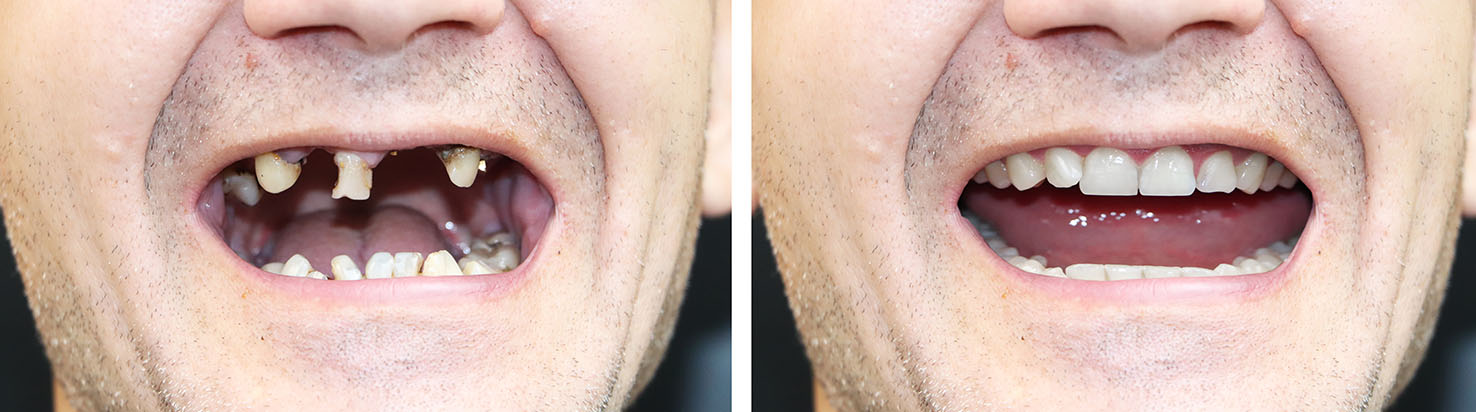
Dental implants are the most advanced and anatomically sound solution available for replacing missing teeth. A dental implant is a small titanium post that is surgically placed into the jawbone, where it fuses with the bone through a process called osseointegration and functions as an artificial tooth root. Once integrated, the implant supports a crown, bridge, or other prosthesis, providing a replacement that looks, feels, and functions like a natural tooth.
Unlike bridges and dentures, dental implants do not rely on neighboring teeth or gum tissue for support. They stand independently, preserving the integrity of adjacent natural teeth and maintaining the health of the jawbone. When a tooth is lost, the bone that surrounded its root begins to resorb because it no longer receives stimulation from chewing forces. Implants transmit chewing forces into the bone just as natural tooth roots do, preventing this resorption and maintaining facial structure over time.
Implant-supported restorations also provide superior stability, function, and esthetics compared to traditional alternatives. Patients can eat a full range of foods, speak naturally, and clean implant-supported teeth just like natural ones. The success rates for dental implants in healthy patients are consistently high—above 95% at 10 years in well-documented studies.
Dental implant treatment unfolds in stages. The implant post is placed in a surgical appointment, followed by a healing period of typically three to six months during which osseointegration occurs. Once the implant has fully integrated, a custom crown, bridge, or other restoration is attached. Throughout the process, temporary restorations maintain appearance and function. The total timeline from placement to final restoration is typically six to nine months for a straightforward single implant.
Ideal implant candidates are in good general health, have adequate jawbone volume to support the implant, and maintain good oral hygiene. Patients with insufficient bone may be candidates for bone grafting before or during implant placement. A comprehensive evaluation including CBCT imaging is performed to assess bone volume, anatomy, and the optimal implant position.
At Cameron Park Dental Care, we evaluate each patient comprehensively to determine whether implants are appropriate and to plan treatment that provides the best possible long-term outcome. Call us at (530) 676-0400 or contact us online to schedule a consultation.
A dental implant is a small titanium post that is surgically placed into the jawbone to serve as an artificial tooth root. Once it fuses with the surrounding bone through osseointegration—a process that typically takes three to six months—the implant provides a stable foundation for a crown, bridge, or other prosthesis. The result is a replacement tooth that looks and functions like a natural one.
Titanium is used because of its biocompatibility—the body does not reject it and bone cells bond to its surface naturally. Zirconia implants are an alternative for patients who prefer a metal-free option. The implant system consists of three components: the implant body (the root), an abutment (the connector between implant and crown), and the crown or prosthesis itself.
With proper care, dental implants can last a lifetime. The titanium implant post, once fully integrated, is extremely durable and is not subject to decay. The crown or prosthesis attached to the implant has a similar lifespan to natural tooth restorations—typically 15 to 25 years or more before replacement may be needed due to normal wear. Many patients have functioning implants that are 20, 25, or more years old.
Long-term success depends on consistent daily oral hygiene, regular professional maintenance, and managing systemic factors that affect implant health such as blood sugar control in diabetic patients and avoiding tobacco. Annual monitoring with X-rays allows early detection of any bone changes around the implant.
Good candidates for dental implants are generally in good health, do not smoke (or are willing to quit), have adequate jawbone volume to support the implant, and are committed to the daily oral hygiene and professional care required for long-term success. Age is generally not a limiting factor for adults; implants are not placed in patients whose jaw growth is not yet complete.
Patients with medical conditions such as diabetes, autoimmune disorders, or a history of certain medications (such as bisphosphonates) require careful evaluation. Patients with insufficient bone may be candidates for bone grafting. The only way to determine candidacy accurately is a comprehensive clinical examination and CBCT imaging—we evaluate each patient individually rather than making assumptions about suitability.
Implant placement is performed under local anesthesia, so the procedure itself should not be painful. Patients feel pressure during drilling and placement but not sharp pain. Sedation options are available for patients who prefer a more relaxed experience. The surgical appointment itself is often shorter than patients expect.
After the anesthetic wears off, moderate soreness, swelling, and bruising in the area are typical for three to five days. Most patients manage post-surgical discomfort well with prescribed or over-the-counter pain medication and ice. Following the post-operative instructions carefully—including the soft diet period—is the most important factor in a comfortable recovery.
The total process from implant placement to final crown delivery typically takes six to nine months for a straightforward single-tooth implant, though this varies by individual. The surgical appointment takes one to two hours. Osseointegration—the healing period during which the implant fuses with the bone—takes three to six months. After integration is confirmed, the final crown is fabricated and placed, which takes an additional two to four weeks.
Some patients may require bone grafting before or at the time of implant placement, which adds time to the overall timeline. Others, in appropriate clinical situations, may be candidates for immediate loading protocols where a temporary crown is placed at the time of implant surgery. We outline the expected timeline for your specific situation at the planning appointment.
Dental implants have one of the highest success rates of any tooth replacement option. In healthy patients who are good candidates and who receive proper post-operative care, success rates are consistently above 95% at 10 years in peer-reviewed research, with many studies reporting even higher rates. Implants placed by experienced clinicians with proper planning and technique have excellent long-term track records.
Risk factors that can reduce success rates include smoking (the most significant modifiable risk factor), uncontrolled diabetes, poor oral hygiene, and certain medical conditions and medications. We discuss individual risk factors at the consultation and make sure patients understand what they can do to maximize the long-term success of their implant.
A dental implant replaces both the tooth root and the crown, standing independently in the jawbone without involving adjacent teeth. It preserves bone, does not require alteration of neighboring teeth, and provides the most anatomically faithful replacement for a missing tooth. Implants are generally the preferred long-term solution for a single missing tooth when the patient is a suitable candidate.
A dental bridge replaces the visible crown portion of a missing tooth by suspending a false tooth between two crowns cemented onto the adjacent teeth. It requires preparing (reshaping) those adjacent teeth, does not address bone loss beneath the gap, and must be cleaned with special floss threaders beneath the bridge. Bridges can be completed more quickly and without surgery, which makes them appropriate in some situations.
Yes—implants can be used to replace any number of missing teeth. A single implant supports a single crown. Two or more implants can support an implant bridge, replacing multiple consecutive missing teeth without crowning adjacent natural teeth. And in full-arch situations, as few as four to six implants can support a complete set of fixed replacement teeth for an entire arch via the All-on-4® or All-on-6® approach.
Implant-supported overdentures, which use two to four implants to stabilize a removable denture, are another option for patients with full-arch tooth loss who want significantly better denture retention than conventional dentures provide. The appropriate number and distribution of implants depends on the specific clinical situation and is planned individually.
Caring for a dental implant is similar to caring for natural teeth—brushing twice daily with a soft toothbrush, flossing once daily (regular floss or an implant-specific floss), and rinsing with an antimicrobial mouthwash when recommended. The implant crown itself cannot decay, but the gum tissue and bone around the implant can be affected by plaque-induced inflammation (peri-implantitis), which is why consistent cleaning is essential.
Regular professional cleanings and monitoring are also required for long-term implant health. At these appointments, we assess the health of the tissue around the implant, check bone levels with X-rays, and professionally clean the implant surface. Peri-implantitis, if it develops, is treatable when caught early but can lead to implant failure if left unaddressed.
At Cameron Park Dental Care, we approach implant treatment with thorough planning, including CBCT imaging to assess bone anatomy and optimal implant positioning, and careful coordination of all phases of treatment. We take the time to ensure patients understand the process, timeline, and expectations fully before any commitment is made.
If you are missing one or more teeth and want to learn whether implants are the right solution for your situation, call us at (530) 676-0400 or reach out online to schedule a consultation in Cameron Park. We look forward to helping you restore a complete, healthy smile.